The problem
Booking a local turf or court worked over phone calls and WhatsApp groups. You would message the venue, wait, get told 6pm was free, gather your team, and find out an hour later that someone else had already taken it.
Venues had the mirror-image problem. They were double-booking slots by accident and leaving others empty because nobody knew they were available.
What we built
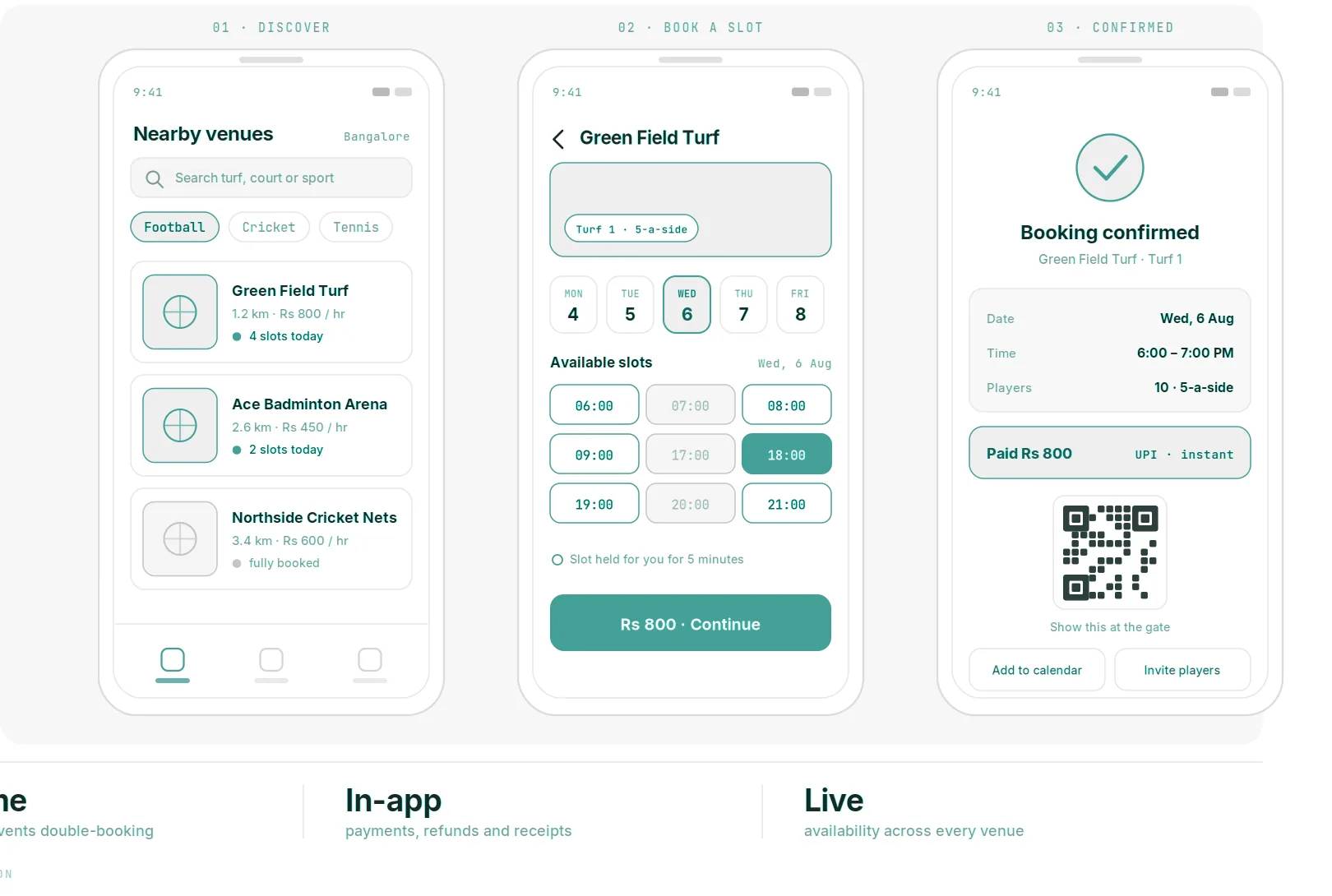
A cross-platform app, one React Native codebase for iOS and Android, covering three things: find a venue near you, see live availability, book and pay without leaving the app.
Discovery is geo-based with filters by sport and distance. The booking flow is a slot grid where taken slots are visibly greyed out rather than silently failing when you tap them. Payment happens in-app, and a confirmation with a QR code lands at the end so there is something to show at the gate.
The hard part, which is not the booking
The hard part is two people tapping the same slot four milliseconds apart.
The obvious implementation, check if the slot is free and if it is then book it, works perfectly in testing, because in testing there is one of you. In production both requests run the check before either one writes. Both are told yes. Both book. Two teams turn up at the same turf.
You cannot fix this in application code. The app runs on multiple servers and they cannot see each other’s decisions.
The fix is to stop asking permission and let the database refuse. A unique constraint on venue and slot means the second insert cannot succeed. A conditional write, update where status is still free, tells you you lost by changing zero rows. And while someone is paying, the slot is held in Redis for five minutes and released if they abandon checkout, so nobody pays for something that vanished mid-transaction.
None of that is clever. But it only shows up when two people want the same thing at the same moment, which is exactly when the app is finally working.
Our role
End to end. Scoping with the venue owners, API and data model, the mobile build, payments integration, and release to both stores.
Talking to the venue owners was more useful than any of the engineering. They were the ones who explained that a slot held during checkout needs to expire fast, because an abandoned cart at 6pm on a Friday costs them a booking.
Where it landed
Booking takes seconds instead of a thread of messages, and venues fill slots that used to go empty. Real-time availability across every venue, one codebase on both platforms, payments and refunds handled in-app.