The problem
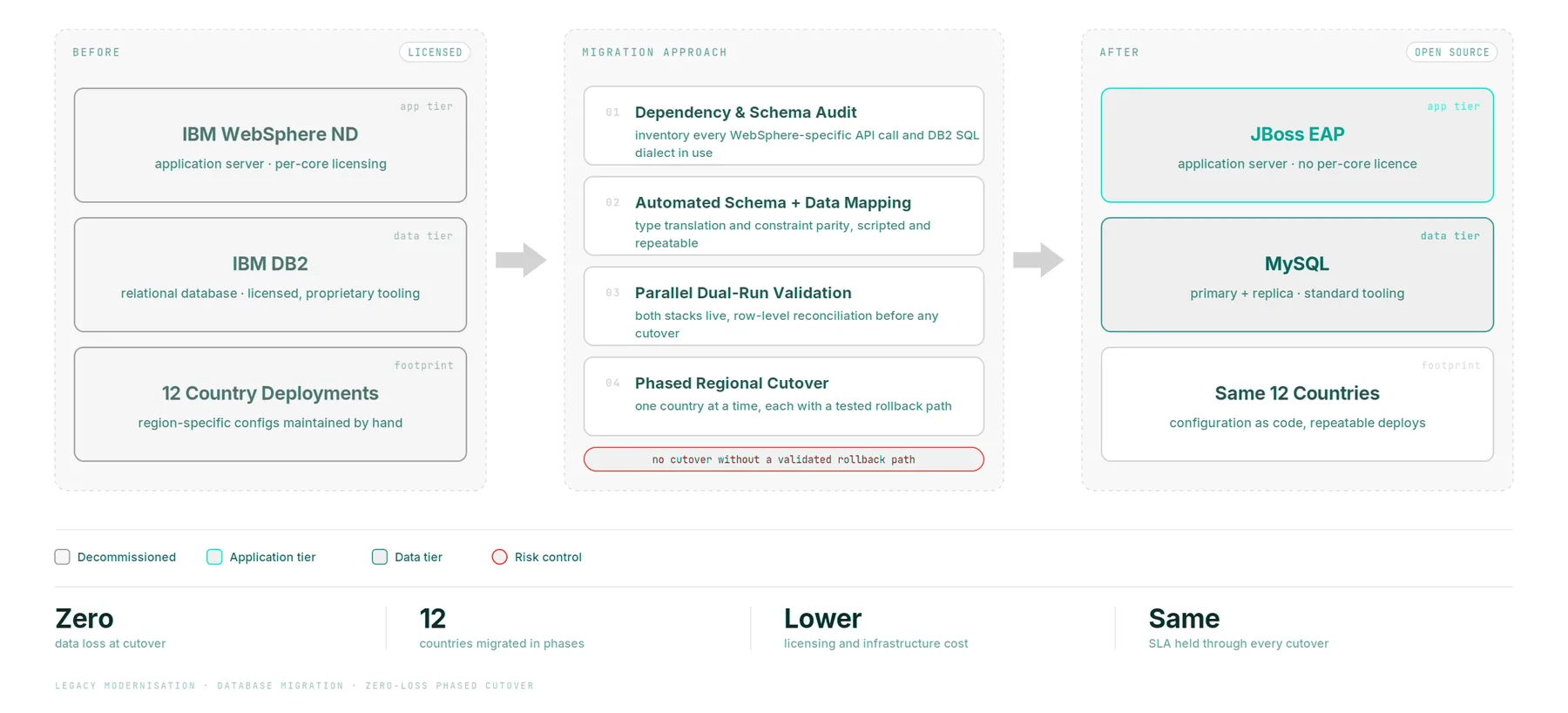
A production application running on IBM WebSphere and DB2, deployed in twelve countries, each with its own regional configuration and its own compliance requirements.
The licensing was expensive and the stack was hard to hire for. Everyone agreed it should move. Nobody wanted to be the person who broke it.
That hesitation is reasonable. Most migration disaster stories start the same way: we will do the switch over the weekend. Freeze the old system Friday night, export, import, repoint everything, go home. Monday morning something did not come across, and now there are two days of new data sitting on top of the problem.
How we actually did it
Four stages, and the boring third one is the whole reason it worked.
Audit. A full inventory of every WebSphere-specific API call and every DB2 SQL dialect quirk in the codebase. You cannot plan a migration around what you assume is in there.
Schema and data mapping. Type translation and constraint parity, written as scripts rather than done by hand, because we were going to run it twelve times and a manual process fails differently each time.
Parallel dual-run. Both stacks live at once. The old one kept serving users exactly as before. The new one received the same writes and served nobody, which meant it was allowed to be wrong without hurting anyone. Then we compared, row by row, on real production data. Every mismatch was a bug: a type that did not translate cleanly, a constraint that behaved differently, a timezone assumption nobody had ever written down. We found those on Tuesday afternoons with the old system still running, instead of at 2am with users locked out.
Phased cutover. One country at a time, each with a rollback path that had actually been tested rather than just documented.
The rule we did not break
No cutover without a validated rollback path.
Not "we know how we would roll back". Tested, on that region’s data, before anyone moved. It cost time and it is the reason the whole programme was uneventful.
Where it landed
Twelve countries migrated. Zero data loss. Licensing and infrastructure cost down, with the same regional footprint and the same reliability.
The cutovers themselves were boring, which is the highest compliment you can pay a migration. By the time we switched, we already knew exactly what the new system was going to do.