The problem
Releases were a scheduled event. Someone would announce a deployment window, a few people would stay late, and there was an unwritten rule about not shipping on Fridays.
That rule is a symptom. If you are afraid to deploy on Friday, what you are really saying is that you do not trust the process and you do not have a fast way back.
What we built
A pipeline that runs the whole way from commit to production without anyone babysitting it.
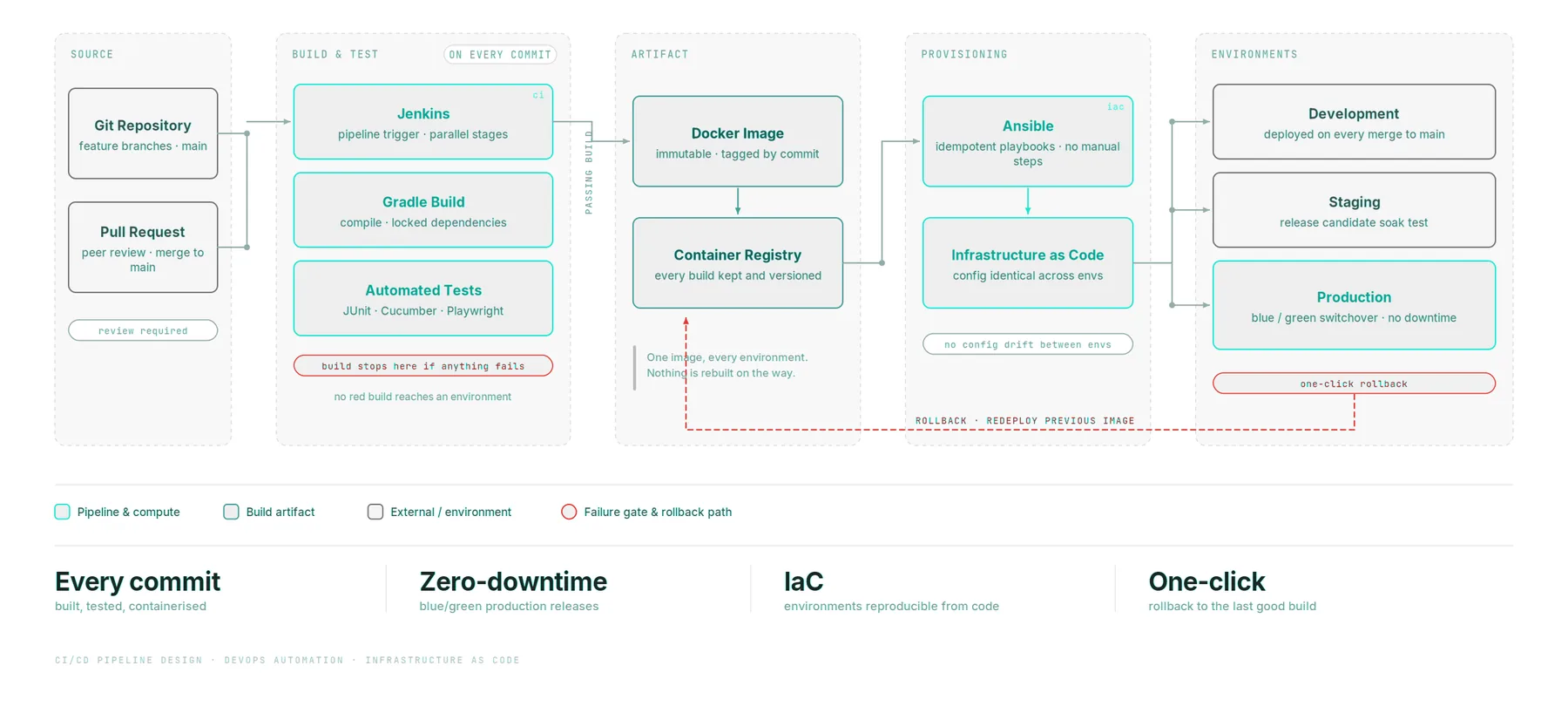
A push triggers Jenkins. Gradle builds and locks dependencies. The test suite runs in parallel stages, unit, integration and browser tests, and the build stops there if anything fails. A passing build produces a tagged Docker image, pushed to a registry.
Ansible provisions and configures the environments. This is the piece that gets skipped most often, and skipping it is why "works in staging" stops meaning anything: if environments are configured by hand they drift, and the drift is invisible until it is not.
From there, every merge deploys to development, release candidates soak in staging, and production goes out blue/green so there is no downtime and the previous version is still sitting there if you need it.
The bit that changed how the team worked
Rollback. Not a runbook, a button. One click back to the last good image.
That sounds like a small feature and it changes everything about how people behave. When going back is cheap, going forward stops being frightening. The Friday rule died on its own within a couple of weeks; nobody had to argue about it.
What we would tell a team starting this
Do it in this order: get the build reproducible first, then the tests trustworthy, then automate the deploy. Teams that automate deployment before their tests are reliable have just built a faster way to ship bugs.
Where it landed
Every commit built, tested and containerised. Environments reproducible from code. Zero-downtime production releases with one-click rollback.
Release cycles went from scheduled events to something nobody thought about much, which was the point.